Saturday, February 26, 2011

Big Fish Eat Little Fish: Overfishing, Climate Change, and Pieter Bruegel the Elder

The other day it was brought to my attention that I should use the latest video from Eli Rosen's Manufactory as a launching point to wax sanctimonious on the fishing industry and the disastrous, perfect storm potential that the concurrence of overfishing and warming water temperatures could have on both marine and human populations.  

While I am always tempted to fight the good fight, and try to educate folks on their dietary ills, or more appropriately in this case, the ills their diet and carbon footprints cause marine ecosystems,  I'll have to defer for now to a couple great books on the subject:  Four Fish: The Future of the Last Wild Food by Paul Greenberg and The End of the Line: How Overfishing Is Changing the World and What We Eat by Charles Clover.  The Independent called the latter, which is now also a film, "the maritime equivalent of [Rachel Carson's] Silent Spring."  I won't try to stand on the shoulder's of giants receiving such high praise from well respected media outlets like The Independent.  But, please do look into these two books, eat fish you catch your-own-damn-self, and of course enjoy Eli's video below.
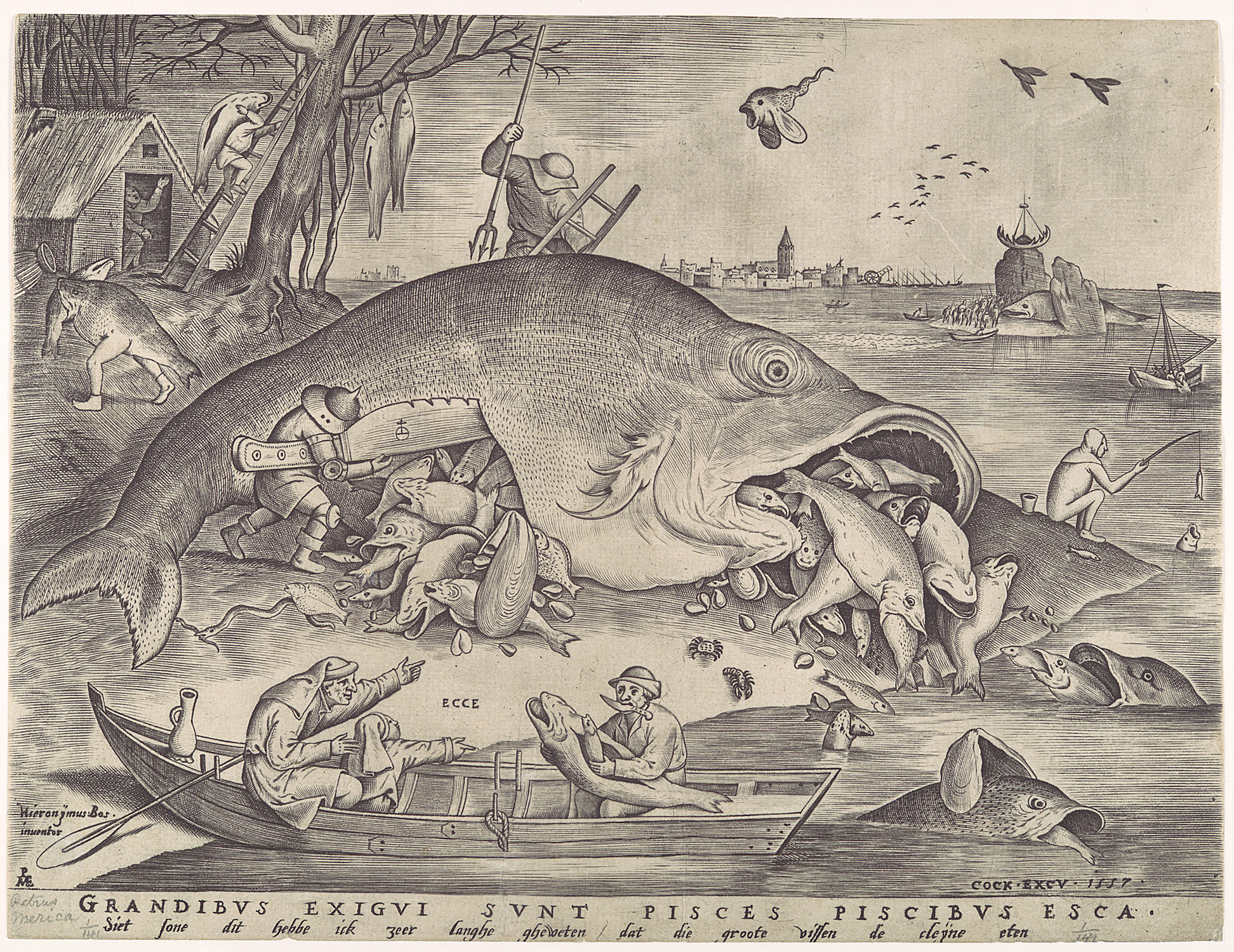


Pieter Bruegel the Elder's Big Fish Eat Little Fish - the painting Eli brought to life with digital technologies

Tuesday, February 22, 2011

Pruning Our Trees

Tamara and I have worked out a division of labor - or more accurately, a division of responsibility, since we'll be sharing the work anyways - by which she is in charge of vegetables, berries, bees, and preservation through drying and I take care of the animals, fruit trees, mushrooms, and canning.

This means learning about the art of the orchardist falls squarely on me.  Fortunately, I have thoroughly browsed Michael Phillips', The Apple Grower: A Guide for the Organic Orchardist, a must own for any grower of fruit trees, and was given a hands on tutorial from Phil of the Philadelphia Orchard Project when we were both helping out at Mill Creek Urban Farm this past summer.

Yesterday, Tamara and I braved the cold to prune our apple trees.  It took us about four hours to finish up three of them.  They have been neglected for a good 15 years and were in pretty bad shape, which makes me optimistic for shorter pruning times in the future.  Still, I don't want to think about the upkeep involved with an actual orchard.

Even on our scale, apples take a lot of work year round to manage, let alone organically, but we are looking forward to it.  I'm even getting excited to purchase my first gallons of neem oil and liquid fish for spraying.  We have a good amount of comfrey to make a tea for spraying as well.  Which starts me wondering how easy it would be to make my own liquid fish?  All I need are fish guts, a blender, and some wire mesh.  It might be worth it with sustainable liquid fish going for about $30 per gallon.  I think I smell a future blog post, complete with video.

Mali trying to help prune

Tamara and I in the top of a tree (she's invisible though)

Saturday, February 19, 2011

Galapagos vacation over, upstate farm project commence.

Reality hit hard Tuesday when we returned to Syracuse from our 10 days in Ecuador and the Galapagos Islands.  Flying into Philadelphia, where all the snow had already melted, was more than a little misleading, inspiring all sorts of phantom-spring enthusiasms.  Of course, our drive north quickly confirmed that winter still had a strong hold on the upstate.

After a day to recover from our homeward travel, Tamara and I were ready to prepare for spring, despite the inclement weather, which as it were, tried to fool us yet again by hovering in the 50s for a couple of days before deciding to dump a bunch of snow on us this morning.

We are about 10 weeks out from the average last frost, which means we are a touch late on starting some of our eggplant, leek, artichoke, herb, and tea transplants.  Tamara got some heirloom basil started yesterday, but this morning marked our first real day of planting - it's February 19th and we are already behind schedule!

The other night laying in bed, we sorted all of our seeds and determined when to start each plant and whether to direct seed or transplant.  We organized and filed them away so we could work our way through all the packets and baggies chronologically.  Consequently this morning was pretty simple.

Back in December we visited Tamara's sister Jo in Philadelphia for the annual fundraiser for her farm, Mill Creek Urban Farm, and scored a whole lot of amazing potting mix from Organic Mechanics in the silent auction.  We dug out a couple of the bags and filled the cells of some seed flats. 

Tamara is a budding master in the art of seed saving so hopefully someday our reliance on purchasing from seed companies will not be so heavy.  I doubt we'll ever need to buy another packet of tomato, pepper, or squash seed, but I'm sure we will.  The allure of seed catalogs is as irresistible as it is dangerous for my bank account.  We bought all of our seeds from High Mowing and Seed Savers Exchange, and had a good amount left over from last year's spending spree with Seeds of Change.  Add to that couple hundred dollars worth of seed all that Tamara has saved and I think we might need to consider acquiring more land.     

Tellingly, after deciding to not overdue it with Eggplant, which can be a little difficult to grow in this climate, we ended up with 4 different varieties, thus, proving our weakness of will when it comes to vegetables.  Little Finger, Rosa Bianca, Imperial Black Beauty, and Listada di Gandia were all sown this morning.

Although we have a decent number of rare, heirloom Scotland Leeks overwintering, we planted a whole lot more this morning as an insurance policy - you can never have too many.  We also decided to try Artichokes again, planting the Imperial Star variety, and doing a little more research as to how to trick them into flowering in their first year.  They are perennial in zones 7-10 and with a little help we think we can do it in zone 6.

We rounded out this mornings planting with hefty amounts of heirloom, Lettuce Leaf Basil, St. John's Wort, and German Chamomile.  All of which we intend to use in a value-added context - canned pesto, packaged medicinal herbs, and dried teas, respectively.

Over the course of the next 10 weeks we'll be starting more and more plants and crowding out the little space we have left in the house.  I'm looking forward to navigating the inevitable obstacle course.  From swimming with sea turtles, sea lions, and sharks last week, to planning and preparing for a busy spring of farming this week, overall, I'd have to say we are feeling pretty lucky these days.

And some pictures by Tamara.


Thursday, February 3, 2011

In the Land of Darwin's Finches and Blue-Footed Boobies

In two day's time Tamara and I will be mid-flight with her family to snorkel, hike, and camp the Galapagos Islands.  We'll be returning around the 15th of February to boxes packed with seeds from High Mowing and Seed Savers Exchange.  Within a few days we will get some of our early transplants going under heat lamps and on windowsills and it won't be long until the ground is ready.  We will also be ordering some apple and plum trees to add to our small collection of older trees as well as some new raspberry and blueberry plants from St. Lawerence Nurseries, who specialize in Northern Climate varietals.  Needless to say we are very excited for both our vacation and the coming spring.

To all our followers out there in cyberspace and  also those who occasionally occupy our collective physical space, I look forward to returning refreshed with some cool pictures to share.  But mostly I am looking forward to getting our farming and homesteading project truly underway.  It is why we relocated to the Finger Lakes and we are both overwhelmingly excited to sow loud - get it?

I will leave you with a few pictures of food and our preparations for vacation.  Talk at you all in a few weeks.  Be well.

Tamara reading to Mali about the Galapagos - we want her to understand why we are abandoning her for two weeks

egg fried in chili topping cheddar stuffed flatbread

looking forward to some time off from this daily trudge out to the pigs

breakfast burritos with some ass-kicking Brooklyn Salsa we bought at the NOFA-NY conference trade show

The Civil War

The Martin Van Buren
The 12 Year Old


There was an old man with a beard 
Who said:  "It was just as I feared!
    Two owls and hen,
    Four larks and a wren 
Have all built their nests in my beard."

Tuesday, February 1, 2011

Photo-documentary of some recent meals

pureed beets with homemade goat cheese

handmade ravioli stuffed with the beet puree

the ravioli on a bed of freshly made croutons and garnished with homemade creme fraiche, balsamic reduction and basil from our incredible windowsill survivor


goat cheese and beet tart in production

same, with addition of bacon and balsamic reduction

again, with addition of candied walnuts

pappardelle with pancetta, sharp locatelli and a softly fried egg, a sort of deconstructed carbonara
chipotle pumpkin bisque with hot spelt bread and Bully Hill's Love My Goat

beer-battered fries, served with bleu cheese stuffed burgers on homemade rolls, but we were too busy stuffing our faces to remember to take pictures

Sunday, January 30, 2011

Pigs Eat Barley Mash, the Movie

Friday night, after-hours at the restaurant, the chef and his brother were brewing some beer.  Some lucky folks stuck around for the fun.  I usually bring home a lot of kitchen scraps at the end of night, scraps that our pigs get really excited about like burned pizza, pasta, past prime vegetables, and your plate scrapings.  On Friday, I got to bring home the mash that was left after they drained off the malt syrup.

I know that a lot of the byproducts from Empire Brewing Co. beer making go to a local pig farm.  At Joe's Pasta Garage, I take home the food that makes the bacon, every night, and, on some rare, special occasions, bring home some really sweet barley mash.  I figured the pigs would really go wild over it.  I won't give it away, rather, I'll let you watch for yourselves.  Ignore the title of the video, it has nothing to do with jewelry or the number 196.  And thank you Tamara for some wonderful videography.


Saturday, January 29, 2011

Briefly On the Future of Farming

My blog post yesterday was admittedly a bit doom and gloom.  But, today is a new day and I'm awake (not sure how after a late night after hours at the restaurant learning how to make beer) and inspired anew.  Let me give you a little back story as context, because a few different things have come together to brighten my morning.

First off, I recently started a twitter account after making fun of it and all my friends who used it for about two years.  I'll admit that I did it as a way to try to route more traffic to the blog, which to a small degree has worked.  I will also admit that I find twitter to be a very useful online tool.  I'm embracing the times,  confessional over.

I mention twitter because this morning I noticed I had a new follower, a rare occurrence, so yippee!  I immediately logged in to learn more about them and it turned out to be the NOFA-NY's Beginning Farmer Coordinator Rachel with whom I staffed the publications table at the conference as part of my volunteer duties (as a brief side note, the community and network building I've already experienced in the week following the conference has been pretty amazing).

I clicked around a bit until I ended up on the blog she writes, on behalf of NOFA, about and for beginning farmers, aptly located on the interweb at nynofabeginningfarmers.wordpress.com.  Much to my initial delight - particularly the delight of my ego - she had some nice things to say about my blog in her post Showing everyone the new face of farming.  She goes on to disclose that the USDA - who I more or less accused of being down right terrible in my post about the conference and again, and more so, yesterday in the wake of the GE alfalfa ruling - some facts that very clearly illustrate how convoluted food policy is in our country.  I didn't realize this until I read her post, but the USDA's Beginning Farmer and Rancher Development Project provides some funding for NOFA-NY's Beginning Farmer program, through which I received a scholarship to attend the conference.  As Alanis Morssette would tell you, that's a little too ironic.

More importantly, and to the point of what I'm actually trying to blog about, she mentioned a very cool project she's getting together.  Rachel is calling out to farmers - beginning, aspiring, experienced, patio, roof-top, windowsill farmers, foragers, whoever, whatever you are - to submit pictures, possibly in the style of Grant Wood's American Gothic, to compile a visual for the new face of farming.  So, if you are growing something, have a plan to grow something, making jam, whatever, I encourage you to send a picture to Rachel at rachel@nofany.org.

The last thing I'll mention, that Rachel's most recent post alerted me to, and that I'm super-psyched about it, is this new farming software nearing release.  AgSquared will allow farmers to manage their farms and their farm data with a number of valuable record keeping and organizational tools.  From devising planting schedules and inventorying seeds and transplants, to analyzing market profits and organizing on farm labor, to using google earth to map out your fields, the software should be an invaluable asset to streamlining small farm management.  Honestly, I can't do the product justice, so you should check out this demo video on their website.  Whether you have a potential use for it or just read this blog for Tamara's pretty pictures, you should watch the demo and see some of the foundational technology that will be crucial to the future of sustainable agriculture.

Michael Pollan talks about the need for a new breed of tech savvy, educated farmers, and he is right on point when he does.  The new face of farming is a diverse one, it needs to continue to grow and take advantage of technological innovations to streamline operations and maximize efficiency.  We are young and ambitious, there is a growing number of us and we are gaining momentum, we have a hoe in one hand and an iPhone in the other.

I saw it first hand at the conference last weekend.  Small farms are the most productive and sustainable, but they require a lot of hard work.  This work can be simplified with the use of newer technologies. Social media sites, like facebook and twitter are great tools to connect the farming community to each other and to their consumer-base.  Software like AgSquared can help the good food revolution grow exponentially by helping to make our farms run smoothly.  Local oriented online distribution outlets - like CNY Bounty and Harvestation in our area - are further augmenting brick and mortar farmer's markets, cutting out the middle men, and diversifying the ways we can get our produce to the people.

So, despite the serious, downer attitude I had yesterday, there are actually many reasons to be hopeful.  Don't let GE alfalfa get you down, let's just do something about it.  The more we - small farmers and our supporters - embrace these new tools the more useful they will become, and the more time we can spend growing good food to feed the future sustainably.  Somebody at the NOFA conference mentioned how we have to relearn all the things that our grandparents generation grew up knowing through experience.  Nothing could be more true.  By using that knowledge and combining it with modern technology, we can create an elixir capable of expanding the local food movement to levels where it begins to nourish significant populations.  Once we achieve that crucial step, the sky is the limit.